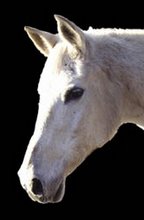
Well, unfortunately, I do think the Spoiled One strained her suspensory ligaments in both hind legs. That was exactly what I was afraid of, and I have been really up and down with my emotions lately. But the reason I have not excercised her at all, is that whenever she moves, her rear fetlocks kind of sag with each step. Nothing dramatic, but she also did develop a small swelling on the right rear cannon bone 2 days ago. We'll see what the vet says.
She probably would have needed to be retired in a few more months anyway, (and I've been expecting it, which is the main reason why I'm always so hypervigilant about her movement) but it's upsetting to have it happen now and in this way!
It is funny though, because she always loves to show off for the other horses and literally "strut her stuff" for them, even more when she is under saddle and going past strange horses. It's like she doesn't want to think of herself as being "old" yet! So, I hope to get her pasture sound and then be able to take her on handwalks down the road and stuff. She just really likes exploring and seeing what's around the bend!
Other than that, she will enjoy simply being a pasture ornament now. :-D The plan has been to get another horse in about 4 months - my schedule and job, etc. probably won't allow for another horse before that. I could start asking my friends for rides again, but most of the people who have enough time to let me come over live too far away for me to go there often. So who knows when I can ride again. Mostly, I'm sad that she got injured and had to be retired already, and even more sad that I was responsible for the "incident."
On the other hand, this has been an absolutely fantastic experience with her so far (worrying aside!). Keeping an older horse healthy, and ideally rideable, is a huge challenge, but I have learned so MUCH during these last 8+ months! I hope she stays around a long time more, so I can keep learning and so she can teach the younger horse I plan to get. The alternative is too frightening, so please God make her recover quick!
Also, muchas gracias to everyone who has commented lately! :-) Sorry if I sound depressed, but I can't help it - I am depressed. My family and best friends are all being very sweet and encouraging, but I just can't help worrying. I will be posting some more cheerful links and stuff soon, though...
L
Thursday, April 5, 2007


Saturday, March 31, 2007
Talk About Goofy!!!
This is just too, too silly. Be careful, don't drink anything while you watch it!
Here is the link: http://www.youtube.com/watch?v=1SmgLtg1Izw
(Sorry, don't know how to embed videos on this page yet)
These people sure have a great marketing team, don't they? But ouch, the number of cliches they managed to squeeze in to one little video...
Have a fabulous weekend all!
L
Here is the link: http://www.youtube.com/watch?v=1SmgLtg1Izw
(Sorry, don't know how to embed videos on this page yet)
These people sure have a great marketing team, don't they? But ouch, the number of cliches they managed to squeeze in to one little video...
Have a fabulous weekend all!
L
Monday, March 26, 2007
Tiny-Scale MiG Part 3
OK, now we are getting into some fun stuff! I have been quite interested in the barefoot horse movement for a couple years now, after I discovered it was not only possible to have high performance barefoot horses but that they often did even better than shod horses. And being able to cure "incurable" lamenesses definitely sounds good to me! This is where pasture management and barefoot come together in my philosophy.
When planning a rotational grazing/MiG program, you will see that you need a "sacrifice area" for the horses to occupy when there is no pasture ready for them to graze. Depending on your property size they may only be able to graze a few hours at a time every few days, or they may spend almost all their time on pasture. Regardless, you need areas where you don't have to worry about trampling hooves, right?
One of the pioneers in the barefoot horse movement, Jaime Jackson, recently came out with a book called "Paddock Paradise," based on the fact that horses are designed to move more or less constantly all day. Wild horses walk/jog in a large, semi-circular pattern around their herd's home territory, and usually cover about 20 miles in a day. I'm not going to go into why that is so important right now, but when horses get at least that much exercise in a day it has BIG health benefits. I have not read the book yet, :-( so obviously I don't know what all he says. I plan to get it ASAP and I'll review it here for your reading delectation when I do! From what I hear, the premise of the book is that he discovered that you can mimic wild horse movement patterns by creating a circular, 10' to 15' wide fenced track. Along this track you will put their food in one spot, their water in another, their salt in another... This shape, rather than the usual open square, etc. paddock encourages horses to move around steadily all day long, rather than simply loafing in their favorite spot all day.
Since I don't have the book yet I don't know how long the track should be at a minimum, or many other specifics. But it sounds very intriguing to me. This would also work really well for a "sacrifice area" that will encourage lots of movement but not "sacrifice" much land.
Fun Factoids: Did you know there are 43,560 square feet in an acre? An acre is officially 220 yards long and 22 yards wide. A perfectly square acre would be about 208.7 feet by 208.7 feet.
Click here for Part 1.
Click here for Part 2.
L
When planning a rotational grazing/MiG program, you will see that you need a "sacrifice area" for the horses to occupy when there is no pasture ready for them to graze. Depending on your property size they may only be able to graze a few hours at a time every few days, or they may spend almost all their time on pasture. Regardless, you need areas where you don't have to worry about trampling hooves, right?
One of the pioneers in the barefoot horse movement, Jaime Jackson, recently came out with a book called "Paddock Paradise," based on the fact that horses are designed to move more or less constantly all day. Wild horses walk/jog in a large, semi-circular pattern around their herd's home territory, and usually cover about 20 miles in a day. I'm not going to go into why that is so important right now, but when horses get at least that much exercise in a day it has BIG health benefits. I have not read the book yet, :-( so obviously I don't know what all he says. I plan to get it ASAP and I'll review it here for your reading delectation when I do! From what I hear, the premise of the book is that he discovered that you can mimic wild horse movement patterns by creating a circular, 10' to 15' wide fenced track. Along this track you will put their food in one spot, their water in another, their salt in another... This shape, rather than the usual open square, etc. paddock encourages horses to move around steadily all day long, rather than simply loafing in their favorite spot all day.
Since I don't have the book yet I don't know how long the track should be at a minimum, or many other specifics. But it sounds very intriguing to me. This would also work really well for a "sacrifice area" that will encourage lots of movement but not "sacrifice" much land.
Fun Factoids: Did you know there are 43,560 square feet in an acre? An acre is officially 220 yards long and 22 yards wide. A perfectly square acre would be about 208.7 feet by 208.7 feet.
Click here for Part 1.
Click here for Part 2.
L
Update on Mira's Leg
She seems to be a LOT more comfortable now. Yay! Yesterday she trotted a little while waiting to be fed, and today not only is she moving almost normally, she actually loped a few steps and then bucked when I was feeding her. That is normal behavior for her (she gets antsy and acts like she is starving!) so I am definitely relieved. The bruise looks its worst right now of course, but I'm still hosing her legs often, and I hope and pray we'll be able to ease her back into work within a couple of weeks. So far it looks like the only damage was the bruise... No swelling, fluid, heat, nothing...
I'm SO glad she's such a tough old gal!
L
I'm SO glad she's such a tough old gal!
L
Sunday, March 25, 2007
Mira's Scary Pasture
Ok, here goes, the story of Mira's "Big Adventure." I got Mira's pasture all ready for her on Friday afternoon, and took her down there and turned her loose. I sat on a stool and had fun watching her run around and graze. She LOVED it - normally in a new pen she will explore the boundaries first, but here she started eating right away! I got some good pictures of her and of the pretty day, and then read the book I brought with me. She was rather agitated when I tried to leave to go up to the house, so I ended up staying there for the next couple hours and then took her back to her normal pen.
After our ride the next morning we went down to the pasture and I turned her loose in it again. I hung around for a while, but then I had to go up to the house to do some stuff. (The house is maybe 100 feet away, max.) She started running around in circles and whinnying like horses do when they feel insecure in a new place. I got her a bucket of her regular feed, which she likes even more than grass, and she started eating it, so I came on up. She immediately started running around again!
Bottom line, after 20+ minutes I wasn't getting anything done because she would not calm down and it was worrying me. She never challenged the electric fence or anything, but she just would NOT settle down. I decided it had been long enough and if she hadn't settled down by now, I wasn't going to be able to try to "ignore her 'till she gives up." Besides, I don't believe in ignoring someone who really is scared. So I went down to get her... Somehow, in the intervening time she had knocked over her plastic water bucket and in the process had bruised her left rear leg. Either that, or she jumped over a pile of branches and bruised it that way.
Here is the bruise:

I spent quite a while hosing off her legs and examining her very, very carefully. Nothing's broken that I can tell, (thank God!) the bruise is hardly even swollen, but it doesn't exactly look nice either. No swelling or heat in any tendon/joint area, but she might be a little warm in the area of the bruise - not sure though. I keep checking for warmth, and palpating her legs, but so far she doesn't react except right on the bruise... She might have a little bruise on her right leg, but it does not seem to be bothering her. She is definitely favoring both her hind legs, which I can understand as she ran around for a while AFTER she gave herself that knock.


I can tell she's enjoying having her usual 4 feedings split into 8 today, and though she doesn't really like getting hosed off, she doesn't mind too much. She actually almost trotted the last time I went out there, I could see her thinking about it and then she walked instead, but she does seem to be feeling better.

Next time: 3rd management-intensive grazing article, with info about fencing and how to figure out the number of paddocks you need for a good rotation schedule. Also, how rotational grazing can help you get rid of almost all parasites.
L
After our ride the next morning we went down to the pasture and I turned her loose in it again. I hung around for a while, but then I had to go up to the house to do some stuff. (The house is maybe 100 feet away, max.) She started running around in circles and whinnying like horses do when they feel insecure in a new place. I got her a bucket of her regular feed, which she likes even more than grass, and she started eating it, so I came on up. She immediately started running around again!
Bottom line, after 20+ minutes I wasn't getting anything done because she would not calm down and it was worrying me. She never challenged the electric fence or anything, but she just would NOT settle down. I decided it had been long enough and if she hadn't settled down by now, I wasn't going to be able to try to "ignore her 'till she gives up." Besides, I don't believe in ignoring someone who really is scared. So I went down to get her... Somehow, in the intervening time she had knocked over her plastic water bucket and in the process had bruised her left rear leg. Either that, or she jumped over a pile of branches and bruised it that way.
Here is the bruise:

I spent quite a while hosing off her legs and examining her very, very carefully. Nothing's broken that I can tell, (thank God!) the bruise is hardly even swollen, but it doesn't exactly look nice either. No swelling or heat in any tendon/joint area, but she might be a little warm in the area of the bruise - not sure though. I keep checking for warmth, and palpating her legs, but so far she doesn't react except right on the bruise... She might have a little bruise on her right leg, but it does not seem to be bothering her. She is definitely favoring both her hind legs, which I can understand as she ran around for a while AFTER she gave herself that knock.
Once the initial tenderness is gone I will do some handwalking to help her keep that circulation going. She puts full weight on all her feet, but she walks slowly and carefully. I have been watching her from the house (she's in her regular pen now) and she seems to be following her usual movement/resting patterns, which is good. She's just slower. I can deal with not riding for a while, even for several weeks if necessary, but I am frustrated because I have been working at slowly and carefully conditioning her for the last 4 months. I just hope this won't be too much of a set-back for her. I'll keep hosing/icing her back legs several times a day for a week or so... Now, if I could just stop feeling guilty - I know I'm overreacting, but... ;-)


1. Right rear leg 2. Left rear leg 3. Bruised left leg, side view.
So, to me it looks like she a. Bruised her leg, possibly slightly bruising the bone, and b. Is stiff and sore from running around whinnying like a goofy 2-year-old.
I can tell she's enjoying having her usual 4 feedings split into 8 today, and though she doesn't really like getting hosed off, she doesn't mind too much. She actually almost trotted the last time I went out there, I could see her thinking about it and then she walked instead, but she does seem to be feeling better.
The one thing I never really expected about horse ownership was the constant worrying, but from all the reading of horse books and blogs and articles that I've done, and the owners I know, I should have realized that if you get a horse, you are "dooming" yourself to a life of intense joy and intense anxiety!
Anyway, the lesson learned: Don't bother to try rotational grazing if you cannot turn out 2 or more horses, together!
Any tips/links from you more experienced horsepeople on keeping her comfortable and healing quickly would be welcome.
Anyway, the lesson learned: Don't bother to try rotational grazing if you cannot turn out 2 or more horses, together!
Any tips/links from you more experienced horsepeople on keeping her comfortable and healing quickly would be welcome.
Next time: 3rd management-intensive grazing article, with info about fencing and how to figure out the number of paddocks you need for a good rotation schedule. Also, how rotational grazing can help you get rid of almost all parasites.
L
Saturday, March 24, 2007
Tiny-Scale MiG Part 2
Okay, I've got the temporary electric tape fence up! It rained a couple days this last week, so it wasn't until Friday after work that I was able to finish the fence and turn Mira into her new pasture.
Here is a picture of Mira exploring the ups and downs of the area:
You can vaguely see the brown electric tape right behind her - sorry for the shadows!
Building Pasture Quality-
Fertilizing a Pasture: How to figure it out.
I'm just going to do a simple, very basic intro to pasture fertilization here. You want productive soil in your pasture. Productive soil will have certain characteristics - it will have plenty of organic matter (humus), good soil structure, a proper balance of minerals and trace elements, active soil bacteria, and plenty of earthworms and good bugs.
Good, productive dirt will look "rich" and often dark; it will smell nice; and if you hold a handful of soil and wet it, it will not turn into slush - it will still maintain a certain structure.
First Principle: Your most important tool to improve and build soil quality is how you manage the grazing on it! This cannot be overemphasized. The synergy of properly managed grazing animals and rest time can do incredible things for a pasture with no other input. In other words, the most important way to improve your land only requires time - not money! And, conversely, no matter how much fertilizer you do put on, you won't get the best results if the management is poor.
Second Principle: To figure out your fertilizer needs, it is necessary to actually do a soil test. Yes, I know, it's a bother. But, it's very important - you wouldn't prescribe supplements for a horse without actually seeing the horse and knowing it's state of health, work, and living conditions, would you? Make sure that whatever lab you use is a good one. I've never used the lab below before, but they sound like an excellent lab with very detailed reccomendations. According to their reply to my email, the basic soil test is $50.00. Kinsey Ag also has a LOT of articles that are very, very thorough - might be hard to just plow through a whole article, but they do have it arranged so you can quickly find answers to specific questions.
Third Principle: Thorvin!!! Thorvin Kelp is highly recommended by the leading pioneers in MiG and grass-fed livestock producers. If you think about it, rain has been slowly leaching minerals and trace nutrients out of land everywhere and washing it out to sea for thousands of years now... It just makes total sense to grab some of those nutrients back and reapply them to the land! You can feed this kelp to the animals or apply it directly to the land - either way you are doing a serious favor to your land and everything that eats off that land. I prefer feeding it to the animals, as that is easiest and they get the benefit fastest that way. Thorvin kelp contains a lot of iodine (good for horse thyroids, and especially I would imagine, horses with Cushing's disease), a wide array of minerals which are in plant form and thus easy to absorb, and also lots of vitamins. The vitamins are still in the kelp because it is freeze-dried at harvest, which preserves the maximum amount of nutrition.
One of the grass-fed "pioneers" Joel Salatin of Polyface Farms swears by Thorvin as a supplements which prevents his (dozens to hundreds) of cattle from getting pinkeye. People have also started doing research on the interesting observation that kelp seems to protect cattle from the effects of toxic endophyte-infected fescue. If I sound like an ad, well, that's because I have been feeding it to Mira for 5 months now and I am very impressed with how shiny her coat is at 27 years of age, how quickly she shed her winter coat this spring (which indicates good hormonal balance) and just her general improvement in looks and health since I got her 8 months ago. Like, she stopped being allergic to bug bites...
Nobody who sees her believes she's in her 20s, and this is a horse who was rescued from starvation, about a year before I got her, by the vet I bought her from! The vet did a good job rehabbing her, and then sold her to me.

She is quite an ordinary horse in terms of conformation as you can see, but the difference between the first picture, shortly after I got her, and the last two pics, is just amazing to me! And no, she does not get much grooming, and the only place I ever use shampoo or conditioner is her mane/tail.
Most horses would eat about 1/2 to 1 ounce of kelp per day - you can feed free choice or add to grain/pellets. 5 pounds lasted me about 4.5 months...
Fourth Principle: To actively build soil quality does take a certain amount of observation. Again, if you are conditioning a show horse's coat, it takes regular observation to figure out what's working and what's not. Just a few minutes a day is plenty for your pastures.
Fifth Principle: Don't worry about plant varieties right now! That can probably come last - just know that you are dramatically improving the quality of nutrition your horses get from whatever is in their pasture already (that is not poisonous, anyway), and remember that many "weeds" are actually beneficial - not only high in nutrition but also often having various trace elements missing in grass, because of their different root lengths, or acting as a tonic. Google "pasture forbs" and you'll be fascinated. In other words, don't obsess if your pasture is full of crabgrass or other harmless weeds!
Click here for Part 1.
Tomorrow, Part 3 in this series: Mira's Big Adventure in the Pasture (it was, unfortunately), and more about how to organize fences for management-intensive grazing.
L
Saturday, March 17, 2007
Tiny-Scale MiG Part 1
 In honor of Saint Patrick's Day, here's an article about that green stuff that our horses love so much!
Mira and I are located on the West Coast, where it only rains at certain times of the year. :-( So we only see green grass for part of the year. If you live somewhere where it rains more often, enjoy it for me!!!
This year the rains started late and we haven't caught up to our normal amount yet, so there is not as much grass as usual, but there is still quite a lot. As I write we are at the height of the "spring flush." The grasses and legumes are all going to seed and need to be harvested like now it I want to get any nutrition out of them!!! (It can be interesting adjusting to the pace/rhythm of life in the country - so many things have to be done at a certain time, if they'll get done at all.)
The challenge the last few weeks is for me to figure out how to harvest and feed as much grass as possible to Mira in as little possible time. We don't have fencing in all areas, and a lot of the fencing we do have is not complete or else not appropriate for containing a horse. In some places it might be possible to tie her out to graze on a long line; however, we are in foothills with a lot of trees - TOO much stuff in the way everywhere.
I love reading, and so I have tried doing my reading outside while I hold Mira's lead rope and let her graze. That works well and she likes it, but of course there is only so long that I can do that before I need to go do chores or whatever!
We also have this clipper with long handles which I have used to clip grass out of odd areas that are too steep for a horse or too crowded for her to get into. It only takes a couple minutes to gather a good armful to toss in for her to eat. She enjoys it so much that I would probably be doing all this work even if I didn't know all the other benefits that horses get from eating fresh green grass!
Below I am going to show you some pictures of how I've arranged temporary fencing, how much I actually cut the grass, and more. But first, some info and basic prinicples on MiG, or management-intensive grazing.
I am the kind of person who really likes doing research, and I've always loved having some subject come to my attention, going and doing a ton of research, and after a week or so of reading up on it, feeling like I have a good grasp of the topic as a whole. Umm, that did NOT happen with MiG. Growing grass seems like such a simple and boring topic, right? (laughs sardonically) I have been seriously reading up on grass farming for over a year now, ever since I subscribed to The Stockman Grass Farmer. This magazine has a lot of very good stuff in it, but boy is it taking me a while to get a handle on this diverse and confusing "field of research." (Get it? Tee hee) Just so you know I am far from an expert, and also don't feel like you're the only one who's confused by how to manage grassland the best way! But the more I learn the more I want to learn... So, I hope you enjoy my story of starting to learn how to manage grass!!!
1. Apparently, most grass is at its peak in nutritional quality of every kind either right before or right as it starts to set seed. Most legumes (clovers) are at their best at the beginning of flowering. Go here to see some great pictures of what different plants look like at this stage. We are getting to the point here where most of the grass is at that point or past already. It happened very fast this year due to all the sun and not much rain the last 2 weeks!
 2. When harvested (eaten/clipped) before setting seed, grass will try to grow back, if not all of the leaf is taken... It needs as much recovery time as possible though, meaning, if an animal keeps coming back and taking a bite every few days, the grass will be so stressed it will give up for that year, and it will take longer to grow the next year. In other words, take about half the stem and then wait for it to grow out at least another couple inches before cutting/biting the same stem again.
This is about as much as I have been cutting:
Grasses store a lot of sugars (carbohydrates) in their roots. This is their "base of operations," literally. When sending up new growth, they use some of that sugar and send it to the tip. Eventually the sunlight helps the plant produce more sugar which then gets stored in the roots. When stressed by constant grazing, the plant keeps trying to restart the growth process by sending up more sugar, which can cause laminitis problems in susceptible horses, as well as causing the plant to use up its reserves. When the next spring comes, it will be a weaker plant. MiG strengthens grass instead, which is the reason why MiG can so dramatically increase production of grass and total health of land and animals.
3. This triangular area is right next to our pond. (Pond is on the left) The area tends to be somewhat wet and almost marshy, and our 3 ducks hang out there a lot, so we call it the "Quackmire." :-D I am putting a very temporary, one-strand electric tape fence up here so Mira can spend a couple days grazing. It is a shady spot so the grass is not as far along the "going to seed" path as the rest around here.
3. This triangular area is right next to our pond. (Pond is on the left) The area tends to be somewhat wet and almost marshy, and our 3 ducks hang out there a lot, so we call it the "Quackmire." :-D I am putting a very temporary, one-strand electric tape fence up here so Mira can spend a couple days grazing. It is a shady spot so the grass is not as far along the "going to seed" path as the rest around here.

Mira respects electric tape quite well, and she'll only be in here as long as the grass is occupying her attention, thus only the one strand.
Part 2: Quickly putting up a temporary electric fence, how to figure out organic fertilization needs, and Thorvin! "Thorvin what?" Wait and see! :-)
L
Wednesday, March 14, 2007
Another Good Website
I just found another good site! This one is really BIG, as in hundreds of articles! www.horse-sense.org. The only problem with this big ol' internet is I'm never going to be able to have time to read everything I'd like to! :-( Tee hee...
I need to get outside now and do some chores before I ride, but I just wanted to stop in and point you all in this cool website's direction.
Coming soon - an article about my experiments with daily, small-scale, management-intensive grazing in the short wet season of the fragile ecosystem we have here.
L
I need to get outside now and do some chores before I ride, but I just wanted to stop in and point you all in this cool website's direction.
Coming soon - an article about my experiments with daily, small-scale, management-intensive grazing in the short wet season of the fragile ecosystem we have here.
L
Monday, March 12, 2007
3 At Once - I'm on a Roll!
Finally, those 2 posts are finished! Please, tell me what you think.
Today was a day off for Mira - not, I regret to say, for me though... I finished work and then went to visit a friend and do a bunch of errands, which took several hours. I'm tired now and my bed is calling, so ta-ta for now! (Just don't forget to scroll down) ;-)
Oh, more pictures coming soon, too. NOW I'll say goodbye!
L
Today was a day off for Mira - not, I regret to say, for me though... I finished work and then went to visit a friend and do a bunch of errands, which took several hours. I'm tired now and my bed is calling, so ta-ta for now! (Just don't forget to scroll down) ;-)
Oh, more pictures coming soon, too. NOW I'll say goodbye!
L
Dreams
I know all about having big dreams. After all, I'm the one who drove my family nuts ever since I could talk by saying "When I grow up, I'm going to________" every day. I have had and still have a LOT of dreams! That may help explain the last sentence on my bio up on the right there! LOL
Recently I've been reading in several places about what I'm going to call "false dreams." The website that finally made me write this was one called horsemanpro.com. The guy who writes it seems like quite a character. He doesn't seem to know what mercy means, and he's only interested in the truth, the bottom line of what something means or what is really supposed to be done in a particular situation. Still, even though his writing is quite, shall we say, abrasive, he has a lot of great points, and I've been learning quite a bit there.
One theme throughout his writing is the subject of amateur horsepeople, people (often women) who dreamed of getting a horse someday and finally did. He is very critical of amateur owners, mainly because he can't stand when people mistreat or abuse an animal because of ignorance and the lack of ability to see problems in what they are doing. He talks a lot about how people grow up watching Black Beauty or reading Black Stallion books and then go out and buy a horse someday and use it to fulfill their dream of long ago, often in the process not learning much about horses, not being willing to be taught or to accept correction, and usually causing damage to the horse mentally or physically because of that (and often to themselves, too). Obviously, that is very selfish to use an animal solely to fulfill your own dreams without learning to do what the horse needs you to do. I don't believe most people ever even have a clue of the extent of what they do to their animals from that cause, which is sad.
I disagree with the guy because he seems to feel that there are very few, if any, real horsepeople out there anymore who consistently attempt to learn and get better and try to do whatever their horse needs, not what they emotionally think it wants. I actually know a lot of people who fit that description of a good horse owner! :-)
So anyway, I've been thinking about the subject of dreams a lot. Dreams are incredible! We just need to make sure that we keep them grounded in truth and reality. For example, if you dream of getting a horse, realize it's going to be a huge commitment. You are taking on the life of a living being, and making certain implicit promises to that horse. You cannot anthropomorphize the horse, and you must not make important decisions out of emotions and feelings. Being responsible for a life means being sober about the impact you will have on that life, and if you cannot afford the time the horse needs anymore, for example, then guess what? You have to either figure out some way to find the time, or sell it ASAP before the horse suffers from neglect. Sure, you can be as goofy or sentimental in small things as you like - go ahead and braid ribbons in the mane & tail if the horse doesn't mind, or put glitter on, or take 10,000 pictures! Have FUN with your dream!!! Just be mature/realistic/emotionally grounded about it.
On a slightly different note, a favorite author of mine, Randy Alcorn, (www.epm.org) says often that "our dreams are always too small." Meaning that what God wants to do in our lives, and what we are hoping He might do for us, are too incredibly different things. Warning: Not talking about riches and power type dreams here, though. A lot of the dreams God has for us have to do with our character, and how we see Him. One of the most amazing songs I've ever heard is called the "Martyr's Song," by Todd Agnew. If you want to catch a tiny glimpse of God's huge heart toward each of His children, listen to this song! It is based on Zephaniah 3:17. Wow, wow, and wow.
L
Recently I've been reading in several places about what I'm going to call "false dreams." The website that finally made me write this was one called horsemanpro.com. The guy who writes it seems like quite a character. He doesn't seem to know what mercy means, and he's only interested in the truth, the bottom line of what something means or what is really supposed to be done in a particular situation. Still, even though his writing is quite, shall we say, abrasive, he has a lot of great points, and I've been learning quite a bit there.
One theme throughout his writing is the subject of amateur horsepeople, people (often women) who dreamed of getting a horse someday and finally did. He is very critical of amateur owners, mainly because he can't stand when people mistreat or abuse an animal because of ignorance and the lack of ability to see problems in what they are doing. He talks a lot about how people grow up watching Black Beauty or reading Black Stallion books and then go out and buy a horse someday and use it to fulfill their dream of long ago, often in the process not learning much about horses, not being willing to be taught or to accept correction, and usually causing damage to the horse mentally or physically because of that (and often to themselves, too). Obviously, that is very selfish to use an animal solely to fulfill your own dreams without learning to do what the horse needs you to do. I don't believe most people ever even have a clue of the extent of what they do to their animals from that cause, which is sad.
I disagree with the guy because he seems to feel that there are very few, if any, real horsepeople out there anymore who consistently attempt to learn and get better and try to do whatever their horse needs, not what they emotionally think it wants. I actually know a lot of people who fit that description of a good horse owner! :-)
So anyway, I've been thinking about the subject of dreams a lot. Dreams are incredible! We just need to make sure that we keep them grounded in truth and reality. For example, if you dream of getting a horse, realize it's going to be a huge commitment. You are taking on the life of a living being, and making certain implicit promises to that horse. You cannot anthropomorphize the horse, and you must not make important decisions out of emotions and feelings. Being responsible for a life means being sober about the impact you will have on that life, and if you cannot afford the time the horse needs anymore, for example, then guess what? You have to either figure out some way to find the time, or sell it ASAP before the horse suffers from neglect. Sure, you can be as goofy or sentimental in small things as you like - go ahead and braid ribbons in the mane & tail if the horse doesn't mind, or put glitter on, or take 10,000 pictures! Have FUN with your dream!!! Just be mature/realistic/emotionally grounded about it.
On a slightly different note, a favorite author of mine, Randy Alcorn, (www.epm.org) says often that "our dreams are always too small." Meaning that what God wants to do in our lives, and what we are hoping He might do for us, are too incredibly different things. Warning: Not talking about riches and power type dreams here, though. A lot of the dreams God has for us have to do with our character, and how we see Him. One of the most amazing songs I've ever heard is called the "Martyr's Song," by Todd Agnew. If you want to catch a tiny glimpse of God's huge heart toward each of His children, listen to this song! It is based on Zephaniah 3:17. Wow, wow, and wow.
L
Why do We Hate the Basics?
I've been wondering about this for a long time. Anybody you ask, on any subject, not just horses, will agree that laying a good foundation first, and often going back to the basics, even when advanced, is a very important practice. In fact, usually articles/books of advice on every subject will stress that the more advanced you are the more important it is to go back to the basics.
So, my question is, why do so few people follow this advice? Yes, the horse world has its share in this, but my rant for today is broader in scope. For every skilled activity there are a lot of people who want to do well, but can't seem to put in the effort necessary. That's why I made a decision a long time ago not to be an "artist." If I put in the hours and practice necessary, I might get pretty good, but it's not where my passion is. It's fine to try things out and see if you like something enough to do it wholeheartedly, to just dabble in it. But, you cross a line if you start saying you love this activity or are committed to something, but you don't ACT at all like what you are saying.
For example, I know a LOT of parents who never really built a solid foundation of trust, love, and obedience with their children. They often have fooled themselves into thinking they have done their best for their children, and thus it can't be their fault that the kids eventually grow up selfish, rebellious, distant, resistant, and unable to relate to other people in a functional, mature, and balanced manner. PLEASE don't take me wrong! There are of course many cases where the parents cannot possibly be blamed for how kids turn out. And unfortunately a lot of times very good people raise their children the best they can, and the kids still make bad choices - every human is ultimately responsible to God for his/her own choices.
But, there are many, many cases I have seen where parents did not do their God-given duty as parents. They did not lay the foundation for life that is the primary job of a parent. I believe that when I have children someday, (hopefully) that my first responsibility will be to make them strong in the basics. Basics like ability to truly love and receive love, ability to adapt to life's challenges, a thirst for knowledge and learning, the ability to be content and have a purposely thankful attitude most of the time, the ability to control anger... etc. This is definitely a hard job! People that have done this have my utmost respect. And yes, just as with horse training, it takes time. A LOT of time, which means sacrifices.
I think knowing the above, and having a standard to attempt to reach, might be very discouraging to contemplate, which might be why people don't usually sit down and think through their parenting goals. But this should NOT make us discouraged. At times it will seem like an overwhelming task, but as Christian parents, if we are truly walking in step with God, being soft to his hand on the reins, we don't have to be perfect! All that is required is to be responsive to Him, and God will take care of the rest! (Some people think that all that is required is to mean well, and have good intentions. NOT TRUE. What I am saying is we need to both mean well and listen for God's voice - we can make mistakes when we truly mean well, but if we are being soft to His cues, he can and will correct us). I believe that gives us a lot of freedom as parents, and should make us give a sigh of relief. ;-D
Also, and very important, God is the God of redemption. If your parents did not do their duty, did not even come close to the standard God has for parents, and if they did a lot of damage to you - guess what! If we are breathing, (which I assume you are if you're reading this!) then no matter what choices you or other people have made, and no matter how badly they affected you, God can begin to restore you to wholeness. It's true. Believe it. I have seen this process happen so many times already in my short life - we're all wounded to some extent as we travel through life, and the older I get the more I realize that the only real way to heal from life is to give myself to God. He is MY Good Shepherd, and that is SOO comforting. 'Cause, as I said above, that means HE is responsible for my life - food, clothes, growth, care, direction, shelter - everything. ALL that I have to worry about is if I'm paying attention to Him and obeying!
"I will repay you for the years the locusts have eaten— the great locust and the young locust, the other locusts and the locust swarm -- my great army that I sent among you." Joel 2:25
God promises to restore the things the locusts have eaten in our lives if we let Him...
Anyway, back to the title of this post. :-) Why do we hate the Basics?
L
So, my question is, why do so few people follow this advice? Yes, the horse world has its share in this, but my rant for today is broader in scope. For every skilled activity there are a lot of people who want to do well, but can't seem to put in the effort necessary. That's why I made a decision a long time ago not to be an "artist." If I put in the hours and practice necessary, I might get pretty good, but it's not where my passion is. It's fine to try things out and see if you like something enough to do it wholeheartedly, to just dabble in it. But, you cross a line if you start saying you love this activity or are committed to something, but you don't ACT at all like what you are saying.
For example, I know a LOT of parents who never really built a solid foundation of trust, love, and obedience with their children. They often have fooled themselves into thinking they have done their best for their children, and thus it can't be their fault that the kids eventually grow up selfish, rebellious, distant, resistant, and unable to relate to other people in a functional, mature, and balanced manner. PLEASE don't take me wrong! There are of course many cases where the parents cannot possibly be blamed for how kids turn out. And unfortunately a lot of times very good people raise their children the best they can, and the kids still make bad choices - every human is ultimately responsible to God for his/her own choices.
But, there are many, many cases I have seen where parents did not do their God-given duty as parents. They did not lay the foundation for life that is the primary job of a parent. I believe that when I have children someday, (hopefully) that my first responsibility will be to make them strong in the basics. Basics like ability to truly love and receive love, ability to adapt to life's challenges, a thirst for knowledge and learning, the ability to be content and have a purposely thankful attitude most of the time, the ability to control anger... etc. This is definitely a hard job! People that have done this have my utmost respect. And yes, just as with horse training, it takes time. A LOT of time, which means sacrifices.
I think knowing the above, and having a standard to attempt to reach, might be very discouraging to contemplate, which might be why people don't usually sit down and think through their parenting goals. But this should NOT make us discouraged. At times it will seem like an overwhelming task, but as Christian parents, if we are truly walking in step with God, being soft to his hand on the reins, we don't have to be perfect! All that is required is to be responsive to Him, and God will take care of the rest! (Some people think that all that is required is to mean well, and have good intentions. NOT TRUE. What I am saying is we need to both mean well and listen for God's voice - we can make mistakes when we truly mean well, but if we are being soft to His cues, he can and will correct us). I believe that gives us a lot of freedom as parents, and should make us give a sigh of relief. ;-D
Also, and very important, God is the God of redemption. If your parents did not do their duty, did not even come close to the standard God has for parents, and if they did a lot of damage to you - guess what! If we are breathing, (which I assume you are if you're reading this!) then no matter what choices you or other people have made, and no matter how badly they affected you, God can begin to restore you to wholeness. It's true. Believe it. I have seen this process happen so many times already in my short life - we're all wounded to some extent as we travel through life, and the older I get the more I realize that the only real way to heal from life is to give myself to God. He is MY Good Shepherd, and that is SOO comforting. 'Cause, as I said above, that means HE is responsible for my life - food, clothes, growth, care, direction, shelter - everything. ALL that I have to worry about is if I'm paying attention to Him and obeying!
"I will repay you for the years the locusts have eaten— the great locust and the young locust, the other locusts and the locust swarm -- my great army that I sent among you." Joel 2:25
God promises to restore the things the locusts have eaten in our lives if we let Him...
Anyway, back to the title of this post. :-) Why do we hate the Basics?
L
Subscribe to:
Posts (Atom)